
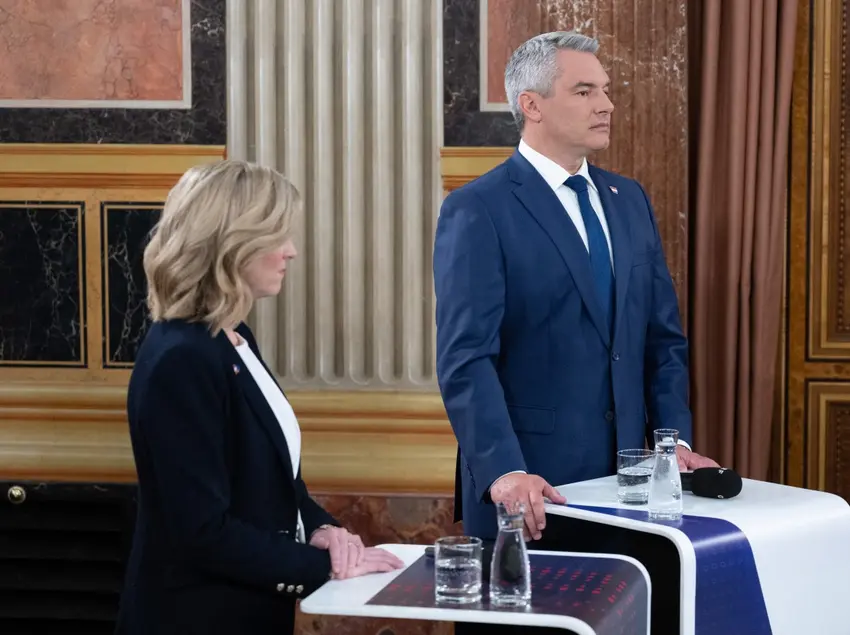
Austria’s historic three-party coalition negotiations officially ended on Friday with NEOS withdrawing from discussions with the Austrian People’s Party (ÖVP) and the Social Democrats (SPÖ).
NEOS leader Beate Meinl-Reisinger announced the decision at a press conference, citing a lack of progress and fundamental disagreements over key issues.
Meinl-Reisinger opened her remarks by acknowledging the problematic global and national context. “The whole world is anything but normal at the beginning of 2025,” she said, referencing challenges such as the war in Ukraine, tensions in the Middle East, political unrest in the United States, and Austria’s own volatile economic situation.
She highlighted Austria’s economic struggles, including insolvencies, inflation, and mass redundancies, stating, “There can be no more business as usual.”
Pensions remain the key sticking point
The NEOS leader identified pensions as the major obstacle during negotiations. While acknowledging the need for “social balance”, she argued for what she called “generational equity” in pension reforms.
“The retirement age cannot be allowed to continue as it is,” she said, calling for long-term changes to address sustainability in Austria’s public finances.
Meinl-Reisinger explained that NEOS approached the coalition talks with “energy” and “ambition,” making proposals as recently as last night.
However, she concluded that discussions with the ÖVP and SPÖ had stalled, describing them as focused more on trading political concessions than finding solutions.
“We have taken steps backwards in the past few days,” she said.
Progress in education, but no bold steps elsewhere
Despite the breakdown, Meinl-Reisinger mentioned progress in areas such as education. She also expressed gratitude to ÖVP leader Karl Nehammer and the Social Democrats for their respectful and confidential discussions.
“We were able to speak to each other respectfully and confidentially,” she said, noting that very little had leaked to the media during the negotiations.
The talks, which began on November 18th, aimed to form Austria’s first three-party coalition since 1945.
Party leaders Karl Nehammer (ÖVP), Andreas Babler (SPÖ), and Beate Meinl-Reisinger (NEOS) had outlined ambitious goals for the coalition, including addressing issues such as economic recovery, healthcare, education, and climate protection.
However, significant policy differences, particularly around taxation and pensions, created challenges that ultimately led to the breakdown of negotiations.
The NEOS leader highlighted her party’s willingness to approach the other parties but emphasised that more was needed. “Bold plans” were missing from the discussions, she said, adding, “We have endeavoured to bring in dynamism and vision.”
Meinl-Reisinger noted that the government programme was intended to be more than just “300 pages of prose” and should have focused on large-scale projects.
What happens next?
With NEOS stepping away, Austria faces two potential paths forward: forming a government with a new majority or calling fresh elections.
A majority government is theoretically possible with the ÖVP and SPÖ alone, but it would be extremely thin, holding just one seat above the 50 percent threshold.
Alternatively, they could bring in the Greens to form a broader coalition with 109 seats, leaving 75 seats in the opposition. However, relations between the ÖVP and Greens have been strained since their own coalition faced significant issues and arguments, particularly in the past few months.
While all parties have stated that they would not form a coalition with the far-right FPÖ, the lack of clear alternatives leaves Austria’s political future uncertain.
BACKGROUND: Historic three-party coalition talks begin in Austria
Comments